Register now to view prices, and place orders!
Register now to view prices, and place orders!
Across the United States, operations teams managing workforce housing, training centers, transitional housing, shelters, student residences and hospitality properties operate with little margin for disruption.
In these environments, furniture is not treated as décor.
Just like HVAC systems, flooring, lighting or plumbing, commercial furniture directly impacts maintenance schedules, operational efficiency, occupant experience and long-term costs.
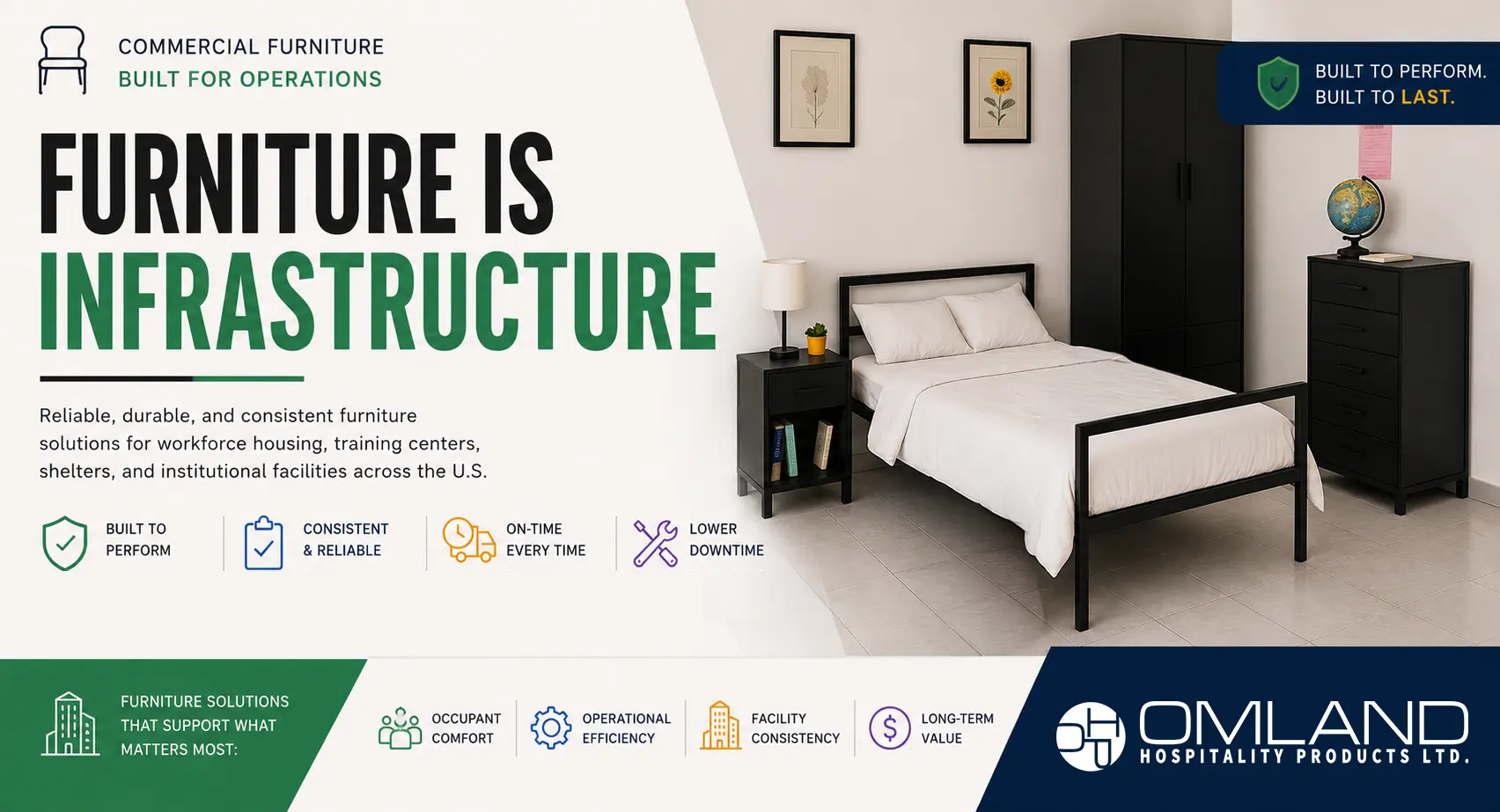
Furniture must withstand constant use, repeated cleaning, high traffic and long operational cycles without frequent replacement.
Standardized furniture across locations simplifies procurement, replacements, room setup and long-term facility management.
Delayed shipments can disrupt occupancy schedules, training launches, renovations and operational planning.
The goal is to minimize downtime, repair frequency and operational disruption caused by low-quality products.
Facilities that perform efficiently rarely focus only on the lowest initial cost.
The bigger risks include inconsistent supply, mismatched replacements, operational downtime and ongoing maintenance issues.
“Facilities that perform well don’t chase short-term savings. They build systems designed for consistency, durability and operational continuity.”
Institutional environments require suppliers who understand operational realities, project timelines, large-scale procurement and long-term consistency.
Well-managed facilities prioritize dependable partnerships that support scalability, reduce disruptions and maintain standards across every property.
Because when operations run smoothly, teams can stay focused on execution, not constant replacements.