Register now to view prices, and place orders!
Register now to view prices, and place orders!
COMMUNITY HOUSING · CANADA & UNITED STATES
OCTOBER 29, 2026 | COMMUNITY HOUSING | RESEARCH & INSIGHTS
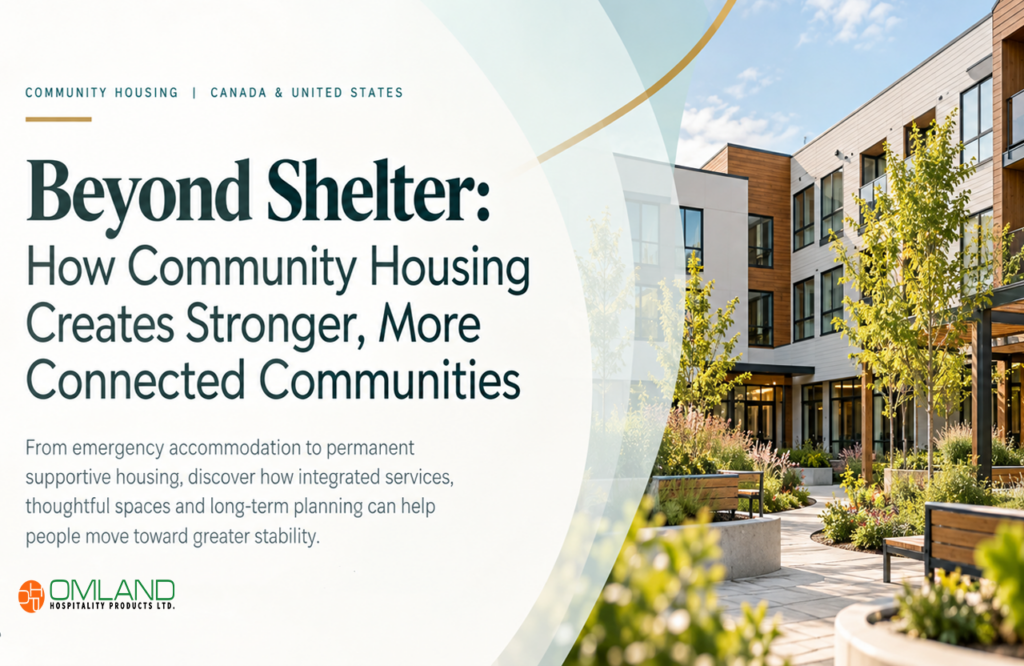
A safe place to live is more than a roof over someone’s head. For people experiencing homelessness, poverty or complex health challenges, lasting stability often depends on access to healthcare, food, employment assistance and dependable human support.
Across Canada and the United States, nonprofit housing providers and community organizations bring these services together through emergency shelters, transitional residences, permanent supportive housing and integrated community hubs. Their work addresses immediate needs while helping residents work toward greater independence.
The bigger picture: Effective community housing brings accommodation, practical services and a sense of belonging together. The building matters, but so do the resources and relationships that help make it a home.
01 · A REAL-WORLD EXAMPLE
Based in Kitchener, Ontario, The Working Centre connects housing with employment resources, food programs, outreach and community enterprises. Its integrated approach responds to challenges that frequently overlap, including unemployment, homelessness and social isolation.
Its Making Home development at 97 Victoria Street North demonstrates how these services can be brought together in one setting.
|
44
Housing units in the development |
3,000
Approximate square feet of medical, counselling and community support space |
2025
Year completion was celebrated with September open houses |
The development also incorporates showers, laundry facilities, a courtyard and a new home for St. John’s Kitchen. Together, these features connect accommodation with everyday necessities and opportunities for community interaction.
Sources: The Working Centre — Who We Are and Making Home; CityNews reporting on the development’s completion.
02 · UNDERSTANDING THE MODELS
Different housing models address different circumstances. The length of stay, available support and eligibility requirements depend on the operator, program and local funding arrangements.
IMMEDIATE NEEDS
Temporary accommodation for people experiencing homelessness. Services may include meals, hygiene facilities, crisis assistance and housing referrals.
NEXT STEPS
Time-limited accommodation combined with services intended to help residents prepare for longer-term housing.
LONG-TERM SUPPORT
Long-term housing with ongoing support that can include tenancy assistance, coordinated healthcare and mental health services.
HOUSING ACCESS
Homes intended for households with limited incomes. On-site care and support are not features of every affordable housing development.
CONNECTED SERVICES
Locations that connect housing or community access with services such as food programs, healthcare, outreach and employment assistance.
03 · THE NUMBERS
Official inventories offer a snapshot of shelter and housing capacity. However, no single directly comparable national count captures every integrated community hub.
The figures below reflect reported 2025 capacity. Some Canadian figures count shelters or facilities, while the U.S. figures count beds. These measures should not be confused or combined into a single facility total.
| Country and housing category | Reported 2025 capacity |
|---|---|
| Canada – Permanent emergency shelters | 608 shelters / 23,483 beds |
| Canada – Transitional housing | 553 facilities / 12,144 beds |
| United States – Emergency shelter category* | 405,028 year-round beds |
| United States – Transitional housing | 83,957 year-round beds |
| United States – Permanent supportive housing | 408,167 year-round beds |
Sources: Housing, Infrastructure and Communities Canada’s Shelter Capacity Report 2025 and the U.S. Department of Housing and Urban Development’s 2025 Annual Homelessness Assessment Report, Exhibit 2.5. HUD’s emergency shelter category includes a small number of Safe Haven beds.
Canada’s figures reflect year-round services open at the end of 2025, with domestic violence shelters reported separately. U.S. figures reflect the January 2025 inventory. Canada’s figures do not represent all permanent supportive or affordable housing.
04 · EXAMPLES IN ACTION
Across North America, established organizations demonstrate different ways to connect housing with care and community support.
ONTARIO, CANADA
Indwell develops affordable supportive housing with on-site teams and community programming. Its published housing directory reports support for more than 1,450 tenants across southwestern Ontario. Services vary by community and residents’ needs.
SEATTLE, UNITED STATES
Downtown Emergency Service Center combines housing with behavioural healthcare and support services. Its Hobson Place development contains 177 studio apartments.
NEW YORK & CONNECTICUT
Its published leasing information lists 21 permanent residences and more than 4,000 housing units owned and/or managed across its portfolio. These are organization-level figures, not national totals.
05 · EVIDENCE AND OUTCOMES
Canada’s At Home/Chez Soi research examined Housing First for people experiencing homelessness and severe mental illness. The findings offer evidence of the importance of access to stable housing.
Among participants receiving Housing First
Among participants receiving usual services
Difference between the reported proportions
Source: Aubry, Nelson and Tsemberis (2015), reviewing Housing First and At Home/Chez Soi findings. The study concerned a specific population; results should not be treated as a universal forecast for every housing program.
Beyond housing retention, community hubs can make everyday essentials easier to access. Meals, showers, laundry, tenancy assistance and healthcare help address practical needs, while common spaces and activities create opportunities for connection.
06 · PLANNING FOR THE FUTURE
Opening a new facility is only the beginning. Nonprofit operators, municipalities, developers and funding partners must consider sustainable funding, appropriate staffing, accessible services and ongoing maintenance.
The physical environment matters, too. Furnishings and equipment should match residents’ needs, room layouts and intensity of use. What works in an emergency shelter may not be the right solution for a family residence or permanent supportive apartment.
A practical procurement strategy can help facilities balance day-to-day functionality, resident comfort and long-term operating costs.
Durability: Choose products suited to the expected frequency and intensity of use.
Cleanability: Consider maintenance requirements and the ability to clean surfaces and textiles effectively.
Repairability: Assess whether items can be repaired rather than replaced entirely.
Accessibility: Match furnishings and layouts to residents’ needs and the intended use of each space.
Lifecycle Cost: Consider purchase price alongside maintenance, replacement and ongoing operating expenses.
Fit for Purpose: Select beds, mattresses, protective bedding, linens, casegoods, storage and common-area furniture according to the facility’s service model.
Aligning furnishings and maintenance plans with the purpose of each facility helps operators create functional, welcoming spaces while managing replacement budgets.
THE TAKEAWAY
Community housing is a long-term investment in stability. Initiatives such as Making Home show how accommodation, practical services and human relationships can work together to create places where people can rebuild daily routines and a sense of belonging.
As housing providers continue to develop and improve their facilities, thoughtful planning, appropriate resources and durable furnishings remain important considerations in creating environments that serve residents and communities over time.
Publication date: October 29, 2026. National capacity figures refer to 2025. Organization-level figures reflect published information and may change.